Last updated 2026-08-19
TL;DR
Open custom cut and wrap in Delaware if you stay inside the federal custom exemption, mark packages Not for Sale, and hold a state business license. Selling meat is the inspected path, a different stack of paper. Your cash goes to the building and the cooler, not to stamps. Hunter wait times follow the cooler queue. Confirm fees with DDA and the Division of Revenue.
Do you need a license for cut and wrap in Delaware?
Yes. You need a Delaware business license, and you need to sit in a lawful operating category. No state card is literally named a cut and wrap license. Custom work for the animal's owner runs under the federal custom exemption. Selling meat is inspected work, and that is a different stack of paper.
People type cut and wrap delaware into a search bar hoping one form exists. It does not.
The Division of Revenue issues the business license for the activity you actually run. [6] Form an LLC and the Division of Corporations files the certificate of formation. A Delaware LLC certificate of formation costs $90 on the Division of Corporations fee schedule. [4] An EIN from the IRS is $0 if you apply on the IRS site. [5]
Custom slaughter and preparation for the owner of the livestock is exempt from continuous inspection under 9 CFR 303.1, so long as the meat is only for that owner's household, nonpaying guests, and employees. [1] The Federal Meat Inspection Act says the same thing in 21 U.S.C. 623. [3] Delaware still runs a meat and poultry program. Custom plants still get reviewed. Treat exempt as different rules, not no rules. [7]
Want a retail case or wholesale boxes? Stop. You need a grant of inspection. Ask the Delaware Department of Agriculture meat and poultry program which door you use, state or federal. Confirm the current application packet with them. Do not guess from a blog.
Local zoning is the silent license. A farm outbuilding in Sussex County is not automatically legal for customer drop-off. Call planning before you buy a saw.
Comparing states? The Alabama start path and the Colorado start path use the same federal custom text behind different state doors.
What actually counts as cut and wrap in Delaware?
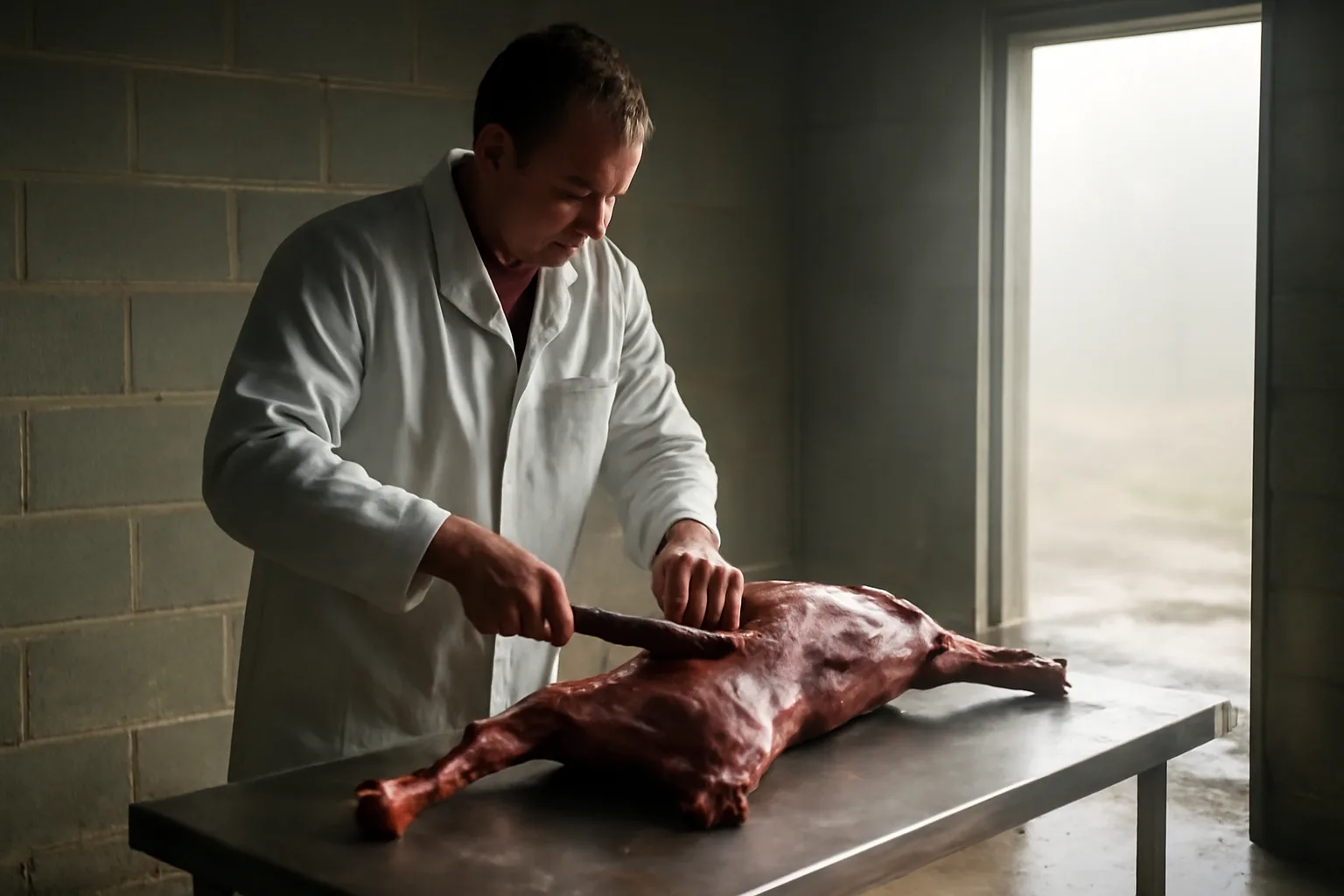
Cut and wrap here means you break a carcass, make household cuts, grind, and package for the person who owned the animal. Hunters drop deer. A family brings a hog they raised. You give them meat back. You do not put that meat in commerce.
That last sentence is the whole business model.
Sell a single steak from that carcass and you left the custom lane. Federal law is blunt about who the meat is for. 9 CFR 303.1 limits custom product to use "exclusively for use, in the household of such owner, by him and members of his household and his nonpaying guests and employees." [1]
Wild deer are not cattle. Hunter-harvested cervids are not the same amenable species stack as livestock under the Federal Meat Inspection Act. A shop that only cuts Delaware deer still needs a business license, a lawful building, and sanitation you can defend. Cut hogs, lambs, or cattle too and the custom exemption language above binds those animals. [3]
A little of everything? Write it down. Reviewers read what you do, not what you meant.
| Work you do | Can that meat be sold? | Main paper |
|---|---|---|
| Custom livestock for the owner | No | Custom-exempt status plus a business license |
| Hunter deer returned to that hunter | Not as inspected red meat | Business license, wildlife rules, sanitation |
| Sell cuts, sausage, or jerky to the public | Only if inspected | Grant of inspection from USDA or the state program |
| Sandwiches or a lunch counter | Separate food rules | Division of Public Health food establishment path |
Do not mix those four in one cooler and hope. Hope is not a control.
How much does it cost to start cut and wrap in Delaware?
Paper is the cheap part. A Delaware LLC certificate of formation costs $90. [4] The LLC annual tax is $300. [8] The business license fee is set by activity code at the Division of Revenue. I will not quote a number that moves by classification. Pull the current schedule and pay that. [6]
The IRS EIN is $0 on the IRS site. [5] Skip the paid "we will get your EIN" outfits. They waste your money.
Nobody publishes a clean statewide budget for a new Delaware custom shop. The closest honest range is this. Already have a code-legal building with water and a way to handle blood and wash water? You are shopping for a walk-in, a bandsaw, a grinder, tables, a vacuum sealer, knives, and a scale. No building yet? The building is the business. Used refrigeration is either a bargain or a leaky regret. I would buy a known-running cooler before a pretty grind room.
| Published paper item | Amount | Where it lives |
|---|---|---|
| LLC certificate of formation | $90 | Division of Corporations fee schedule [4] |
| LLC annual tax | $300 | Division of Corporations annual tax page [8] |
| IRS EIN | $0 | IRS online EIN application [5] |
| Business license | activity code fee, confirm | Division of Revenue [6] |
Insurance stops being optional the day hunters park in your lot. Get general liability and product liability quotes from a broker who has written food or farm accounts. Rates move. I have no public Delaware premium table that is safe to reprint.
Workers' compensation applies to most Delaware employers once you have employees. Confirm coverage duties with the Department of Labor before you hire a Saturday helper and call it a favor. [13]
Delaware does not run a general retail sales tax the way Maryland and Pennsylvania do. You still have a business license and gross receipts tax. Confirm how your processing tickets get classified with Revenue before you print a price list. [9]
Skip the smokehouse palace in year one unless you already have a sausage queue. A second vacuum sealer beats a trophy tumbler.
For how another state talks about startup cash, see cut and wrap cost in Alabama. Different state. Same lesson. Steel costs more than stamps.
How much does cut and wrap cost a Delaware hunter?
There is no official Delaware price list for deer processing. Shops set their own tickets. I will not invent an average and pretend a board published it.
Call three plants and ask for this year's basic cut and wrap price on a skinned deer, plus the add-on list for burger, snack sticks, and jerky. That is the market. During peak week after opening day, some shops stop taking animals. Price is not the only rationing tool. Cooler space is.
As the shop, price for labor and for the days the carcass occupies a rail. Cheap advertised deer specials fill the box and starve January.
Value-added products eat time. Charge for that time or stop offering them. A $2 stick special that ties up the grinder for four hours is not a special. It is a donation.
Deposits help. People vanish after a warm spell.
How long does cut and wrap take in Delaware?
There is no statutory clock. Nobody at Legislative Hall published a rule that a deer must be done in five days.
For a hunter, hang time plus the shop's queue is the wait. In a cold cooler, many plants hang a few days to a couple of weeks. The actual breaking and wrapping is often a couple of hours of table time, not a couple of weeks of sawing. Peak November drags on pickup because the rail is full.
Opening a shop, the long pole is usually zoning, construction, refrigeration install, and whatever review the meat program schedules. I will not promise a week count. Confirm current review timelines with the Delaware Department of Agriculture. No one can honestly guarantee an approval date from a desk in another town. [7]
County land use often moves slower than the state license printout. Waiting on a septic alteration? Budget in months, not weekends. [14]
The same federal custom text shows up in Alaska's start guide. The weather is different. The "how long" answer is still the cooler and the county, not a mythic state stopwatch.
What federal custom-exempt rules bind a Delaware shop?
Read 9 CFR 303.1 and 9 CFR 316.16 before you print labels. [1][2]
Custom product has to be marked. 9 CFR 316.16 requires custom product to be marked "Not for Sale" in letters at least three-eighths inch in height, at the time of preparation. [2] That is not a suggestion. Stamp it. Print it. Make it readable. Closed, properly labeled containers can change the marking detail. Read the section. Do not invent a prettier stamp.
You cannot be in the business of buying and selling carcasses and still claim the custom exemption. [1][3] FSIS still reviews custom-exempt operations. Directive 5930.1 is the review process document. [10]
Sanitation is not optional because you skip daily inspection. 9 CFR 416 is the sanitation frame official plants live in, and custom reviewers still look at whether your room is cleanable, your water is potable, and your inedible is actually leaving the building. [11]
Keep owner records. Who brought the animal. What you made. What left. If you cannot reconstruct a Saturday in November, you are running a pile of meat, not a plant.
I would hang a copy of 303.1 in the office. Not for decoration. For the argument you will have with a cousin who wants to "just sell a few packs."
Which Delaware offices should get your paper first?
Order matters.
First, decide the entity. An LLC is what I would file if there will be a partner or a real lease. A sole prop is fine if it is you, a saw, and a farm you already own. File with the Division of Corporations if you need an entity. [4]
Second, get the EIN. [5]
Third, call county land use. New Castle, Kent, or Sussex. Ask if a custom meat shop with hunter drop-off is allowed on that parcel. Get it in writing if you can.
Fourth, water and wastewater. Public sewer is simpler. On-site systems go through DNREC septic rules. Blood and floor waste are not a household washing machine. [14]
Fifth, the Division of Revenue business license. [6] Gross receipts filings ride with that world. [9]
Sixth, talk to the Delaware Department of Agriculture meat and poultry program about custom operations and any registration or review they want. Confirm the current packet. [7]
Seventh, if you will serve food or run a retail counter that is not custom pickup, talk to the Division of Public Health. That is a different permit family.
Delaware One Stop is a portal, not a substitute for those calls.
The California license walk-through is useful only as a reminder that state doors do not copy each other. Federal custom text travels. County zoning does not.
Want another small-state comparison? Arkansas start notes show the same federal floor with a different agriculture department on top.
Do you need a HACCP plan for Delaware cut and wrap?
A true custom-exempt plant not under a grant of inspection is not automatically in federal HACCP. 9 CFR 417 is written for official establishments. [12] That does not mean you should run without a written sanitation and process plan.
I would still write SSOPs, a cooler temperature log, a calibration log for the thermometer you actually use, and a simple flow for deer versus hog days. Reviewers and insurers both like paper that looks like you thought about the dirty step.
A full 417-style HACCP plan becomes real the day you apply for inspection so you can sell. [12]
Confirm with DDA whether they want a written plan on file for custom plants. Do not take my preference as their rule. [7]
Want a starter packet instead of building forms from a blank page? CutWrapPath sells a $179 one-time HACCP + Deer-Season Kit. Use it or ignore it. The logs only work if you fill them out.
Blank binders impress no one.
How do deer drop-offs and CWD rules work in Delaware?
Delaware hunters follow DNREC Division of Fish and Wildlife rules for seasons, tagging, and reporting. [15] Your shop should not be the place a tag disappears.
Chronic wasting disease rules change when nearby states find cases. I am not going to lock a disease-status sentence into this page. Read the current DNREC deer and CWD guidance before you accept an out-of-state carcass or a whole head. [15]
Ask every hunter where the animal was killed. Write it down.
Cap the daily intake. A full cooler is how you get sour meat and angry Saturday texts.
Bone barrels and hides need a renderer or a lawful disposal path before opening day, not during it. If you cannot name the truck, you are not open.
I would post intake hours and stick to them. Unlimited drop-off is how a one-person shop dies in week two.
What zoning, water, and building papers hit first?
This is where shops die.
A pole barn that was fine for tractors may fail as a food room. You need smooth, cleanable surfaces, hot water, lights that do not dump dust, a pest story that is not a shop cat, and a floor that drains.
On a well? Test it. On a septic system? Assume you need a designer and a DNREC look. [14] I have seen more calendars wrecked by drainfields than by license forms.
Parking for trucks with a deer in the bed is a neighbor issue. Screen it if you can. Do not become the smell complaint on a cul-de-sac.
I would not pour a new floor until zoning says the use is allowed. Concrete is stubborn.
Building permits sit with the county or the municipality. Confirm that locally. New Castle County land use, Kent County planning, and Sussex County planning do not share one counter.
Hot water capacity is a boring item that shuts you down. Size the heater for washdown, not for a bathroom sink.
Can you sell sausage, jerky, or extra meat in Delaware?
Not from custom livestock. That meat is not for sale. [2]
You can sell your labor. That is the custom fee. You can fold packaging into the ticket. You cannot buy a live hog, cut it, and retail the chops unless you are inspected.
Hunter-owned deer returning to that hunter is not a retail sale of venison. Charging for the work is the business.
Want a freezer case of pork sausage with your name on it? Budget for a grant of inspection, a HACCP plan under 9 CFR 417, and a lot more sanitation documentation. [12][7] That path is honest. It is also slower and more expensive.
Inspected and custom in one building is possible in some layouts with real separation. It is also how people contaminate a good custom business with a half-built retail dream. I would master November deer before I chased a grant.
See the Arizona license question if you like comparing state doors. Federal custom rules travel. State doors do not.
What first-year work actually eats a Delaware calendar?
November. That is the honest answer.
You will spend summer on the building and the paper. You will spend October testing the cooler and the sealer. You will spend November arguing with a bandsaw and a backlog.
Write an intake sheet. Hunter name, phone, harvest date, county, special instructions, deposit. Take the deposit.
Train one other person on wrap and grind if you can. Solo shops break when a blade nicks a hand.
Keep custom livestock days and deer days from turning into one sticky counter if you do both.
Track every animal in and every box out. That habit is how you survive a "you lost my backstraps" night.
Renewals sneak up. LLC annual tax, the business license cycle, insurance, any DDA registration. Put them on a calendar. [4][6][8]
I would rather turn animals away in week one than sour a cooler. Pride is a terrible inventory system.
What would I do if I opened a Delaware shop next season?
I would pick the county first, not the saw. I would confirm zoning in writing. I would talk to DDA before I ordered equipment. I would file the LLC only after the parcel works. [4][7]
I would buy a reliable walk-in, a serviceable bandsaw, a grinder I can get parts for, and a vacuum sealer with spare bags. I would not buy a retail display case.
I would print Not for Sale labels at three-eighths inch before I opened the door. [2]
I would reread DNREC's current deer pages the week before season, every year. [15]
I would keep the first season ugly and on time rather than pretty and late.
CutWrapPath is an independent publisher, not a law firm and not a processor. Want the kit? It is on /start. The public rules above still apply if you never click that.
Confirm every fee, form, and review slot with the board that owns it. This page is a map. It is not their stamp.
Frequently asked questions
Do you need a license for cut and wrap in Delaware?
Yes. You need a Delaware business license from the Division of Revenue, plus entity papers if you form an LLC. No card is titled cut and wrap license. Custom work also sits under 9 CFR 303.1. Selling meat needs a grant of inspection. Confirm current forms with Revenue and the Department of Agriculture.
How much does cut and wrap cost in Delaware?
There is no official statewide ticket for hunters and no published build-out survey for new shops. Entity paper is cheap. An LLC filing is $90 and the LLC annual tax is $300. The business license fee depends on activity code. The real bill is the building, cooler, and labor. Call three shops for this year's deer prices.
How long does cut and wrap take in Delaware?
No statute sets a turnaround. Hunters wait on hang time and the shop queue, often days to a couple of weeks in season, while table work is usually hours. Opening a shop takes as long as zoning, construction, septic, and any DDA review take. Confirm those timelines with the county and the Department of Agriculture. Nobody can honestly guarantee a date.
Can I process deer on my farm without a business license?
Charging neighbors and running customer drop-off? Treat it as a business and get the Division of Revenue license. Doing your own deer in your own kitchen is a different fact pattern. Once money and other people's animals show up, you are in licensing, zoning, and sanitation territory. Confirm gray cases with Revenue and DDA, not with a group chat.
Is a HACCP plan required for custom-exempt work?
Federal 9 CFR 417 HACCP is written for official inspected establishments. A custom-only shop is not automatically in that part. Written SSOPs and temperature logs are still what I would keep. Ask the Delaware Department of Agriculture what they want on file. Do not assume a blank wall passes review.
Can I sell extra burger from a customer's hog?
No. Custom livestock product is not for sale. 9 CFR 316.16 requires a Not for Sale mark. You bill the owner for labor. Want to retail sausage or extra trim? You need a grant of inspection and the sanitation stack that comes with it. One "favor" sale can wreck the exemption.
Does Delaware charge sales tax on processing?
Delaware does not run a general retail sales tax like neighboring states. You still owe the business license and gross receipts tax treatment that Revenue assigns to your activity. Confirm how custom processing tickets are classified before you print invoices. Do not copy a Maryland tax line onto a Delaware ticket.
Do I need USDA inspection to wrap hunter deer?
Not to return a hunter's own deer to that hunter. USDA daily inspection is the path for selling amenable meat in commerce. You still need a lawful shop, a business license, and sanitation you can defend. If you also cut cattle, swine, sheep, or goats for owners, stay inside the custom exemption or get inspected.
What size do Not for Sale letters have to be?
9 CFR 316.16 says custom prepared carcasses and parts shall be marked Not for Sale in letters at least three-eighths inch in height at the time of preparation. Closed, properly labeled containers have their own wrinkle in that section. Print the mark so a reviewer can read it without a squint. Tiny script on a smear of fat does not count.
Can I run cut and wrap out of a shared kitchen?
I would not. Blood, hair, and raw carcass work fight with bakery or catering schedules. Zoning, wastewater, and cooler separation get ugly fast in a rented commissary. A dedicated room with a drain, hot water, and a door you control is the boring setup that actually works. Confirm any shared-use idea with DDA and the health side before you sign a lease.
What if I also want to slaughter?
Slaughter for the animal's owner can sit in the same custom-exempt world as cutting, with more blood, more wastewater, and more review. Slaughter for sale needs inspection. Stun, stick, and rail design are not a weekend add-on. Talk to DDA before you pour a kill floor. I would learn cutting first unless you already know slaughter work.
Who inspects a custom shop in Delaware?
Custom-exempt plants are not under daily carcass-by-carcass inspection. They still get reviewed. FSIS Directive 5930.1 describes the federal custom-exempt review process. Delaware's Department of Agriculture meat and poultry program is the state office to call about who shows up at your door. Confirm the current review path. Do not assume nobody ever visits.
How do I handle wastewater from a cut room?
Do not dump blood and floor waste into a household septic field and hope. Public sewer is simpler if the utility will take the load. On-site systems go through DNREC's septic rules and often need a designer. Get that answer before you advertise deer season. A failed drainfield will close you faster than a missing stamp.
Do I need workers' compensation if I hire one helper?
Most Delaware employers need workers' compensation once they have employees. A Saturday kid with a knife is not a paperwork-free favor. Confirm coverage duties with the Department of Labor before opening day. Sole-owner shops without employees sit in a different fact pattern. Ask, then buy the policy that matches what you actually staff.
Sources
- eCFR 9 CFR 303.1 Exemptions: Custom slaughter and preparation for the owner is exempt from continuous inspection when product is only for that owner's household, nonpaying guests, and employees.
- eCFR 9 CFR 316.16 Custom prepared products to be marked Not for Sale: Custom prepared carcasses and parts must be marked Not for Sale in letters at least three-eighths inch in height at the time of preparation.
- 21 U.S.C. § 623 Exemptions from inspection requirements: The Federal Meat Inspection Act exempts certain owner and custom household-use slaughter and preparation from the Act's continuous inspection provisions.
- IRS Apply for an Employer Identification Number (EIN) online: Businesses can apply for an EIN online at no cost through IRS.gov.
- Delaware Department of Agriculture, Food Products Inspection: The Delaware Department of Agriculture administers food products inspection, including meat and poultry inspection functions.
- Delaware Division of Corporations, pay annual taxes: The annual tax for a Delaware limited liability company is $300.
- Delaware Division of Revenue, Gross Receipts Tax: Delaware businesses file and pay gross receipts tax under the state's business license tax system rather than a general retail sales tax.
- USDA FSIS Directive 5930.1 Custom Exempt Review Process: FSIS reviews custom-exempt operations under a documented custom exempt review process.
- eCFR 9 CFR Part 416 Sanitation: Federal sanitation regulations for official meat establishments set the cleanable facility, water, and inedible-handling frame reviewers still use as a reference.
- eCFR 9 CFR Part 417 Hazard Analysis and Critical Control Point (HACCP) Systems: Federal HACCP requirements in part 417 apply to official inspected establishments, not automatically to custom-exempt-only plants.
- Delaware Department of Labor, Workers' Compensation for employers: Delaware employers must determine and meet workers' compensation coverage duties through the Department of Labor.
- DNREC, Septic systems: On-site wastewater systems in Delaware are regulated by DNREC and require proper design and permitting.
- DNREC Division of Fish and Wildlife, Deer hunting: Delaware deer harvest, tagging, and related hunter rules are set by DNREC Division of Fish and Wildlife.